

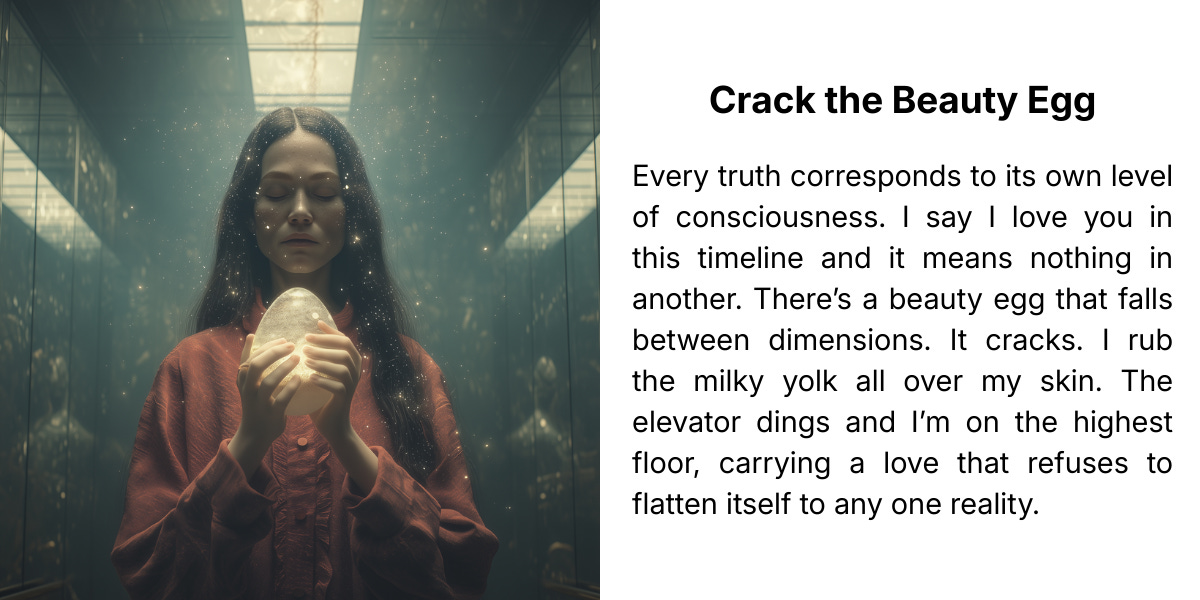
Love doesn’t move in straight lines. It doesn’t start when someone arrives and end when they leave. It slips out of time—lodging in your body, in a branching timeline, in a moment that spirals back.
Where did you leave yours? Not the person—the love itself. The energy you poured into them and never called back. The piece that was taken. The fragment still standing in a room twenty years ago, waiting for you to return.
When love has nowhere safe to go, it goes into hiding. It tucks itself into a childhood memory, an unfinished conversation, a hotel room you haven’t walked through in years. It lives on as a charge in your chest, a knot in your stomach, a recurring dream that won’t let you forget something is still waiting there.
Dreams track this with more precision than memory. They don’t care about the story of what happened—they care about where your life force got left behind. Night after night, they walk you back to the scenes where you abandoned yourself, over-gave, froze, or lost something you never got to grieve. Your dreams are not punishing you. They are showing you where reunion with yourself is still possible.
This is my field guide to those returns: the relationship marathons I quit, the first heartbreak that earned me my stripes, the places I chose to stay stuck rather than forgive, the light I recovered from the darkness, and the spiral branch of love that refuses to stay linear.
These dreams taught me this: when you go back for your love, you are not going back to fix the past—you are going back to bring yourself home.

Love Keeps a Ledger
My dream guides show me how long-term relationships are like marathons. In this race, I’m running alongside an ex, carrying our collective baggage. As I fall behind, he neither waits nor helps to lighten my load. “I quit,” I say. I tell him I won’t be completing this journey with him—he’s proven to be a poor partner. I choose to cross the finish line with someone else.

Even though I left that relationship long ago, the baggage comes back to haunt me. Almost exactly two years later, I dream the same ex has left his baggage behind—clothes, cell phone, wallet. In the dream, I steal all the cash he has. I feel conflicted, but I also feel as if I’m reconciling a debt. I wake up and realize there is a love deficit here.

But the money isn’t the love. It’s just the symbol of what was owed. Twenty-two days later, we meet again in another dream. We’re in a hotel room past our checkout time and have overstayed our welcome. The energy between us is complicated—charged and tender and unfinished. And then I feel it: the love that got left behind. Not the memory of loving him, but the actual leftover charge that was abandoned when I left. The energy I poured in and never called back. This is what the money was pointing to all along. This is what I came back for.
Love keeps a ledger, even when we don’t. When the giving is one-sided, a love deficit accumulates. Dreams will show you exactly where you left your love behind. Reclaiming it isn’t always about taking something back from them—sometimes it’s about going back for what you abandoned. The love you poured out doesn’t disappear when you leave. It stays lodged in that timeline, in that relationship, waiting for you to return and call it back home.
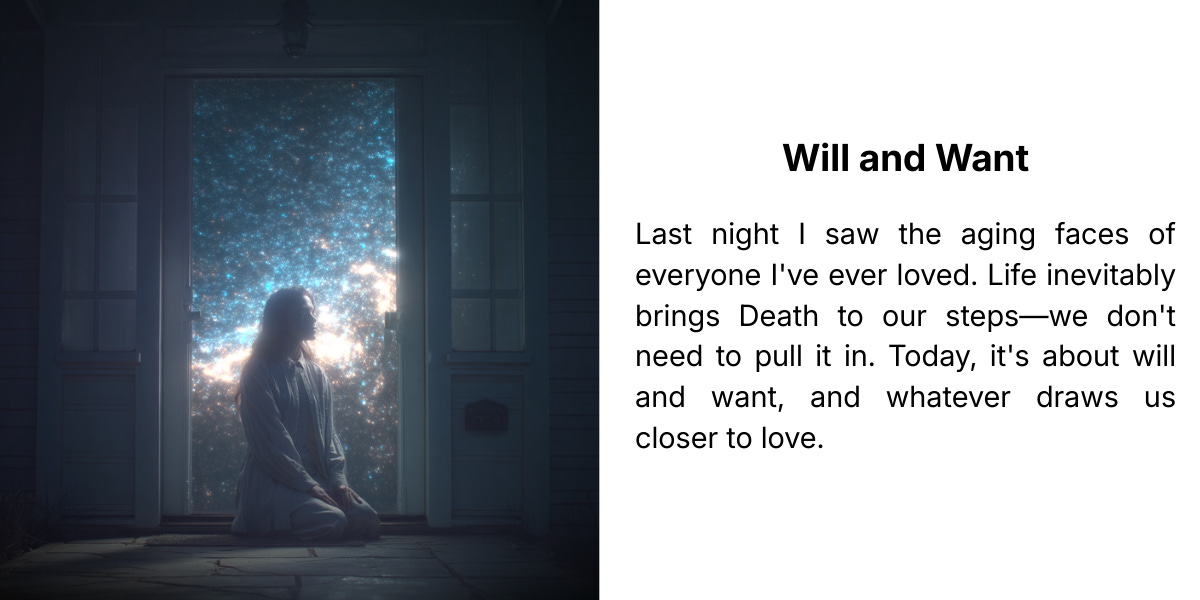
My First Heartbreak
This is not a dream. This is me as a two-year-old on Easter. My mother has just gifted me and the girl next door inflatable bunnies as tall as us. Mine is purple—my favorite color—hers is pink, and I don’t think I could love anything as much as I love my purple bunny. Tragically, my love is short-lived, and the heartbreak is forever. For reasons unknown to me, the girl next door grabs her toothbrush and pops my bunny. My heart deflates.

In a dream at age 41, my father takes me back in time. He says he wants to heal my heart. In his hands are two bunnies—one purple and one pink with white stripes. I reach for my purple bunny, thinking it’s a reunion, and he pulls it back. He hands me the other instead. He says, “You’ve earned these stripes.”

The dream doesn’t give me back my purple bunny. That’s not how healing works. My father shows me I can’t undo the wound—but I can transform what it made me into. The stripes are everything I’ve lived through since that first heartbreak: every love that didn’t last, every trust that got broken, every time I chose to stay open anyway. You don’t earn your stripes by forgetting the pain. You earn them by integrating it into who you’ve become.
I’d Rather Stay Stuck
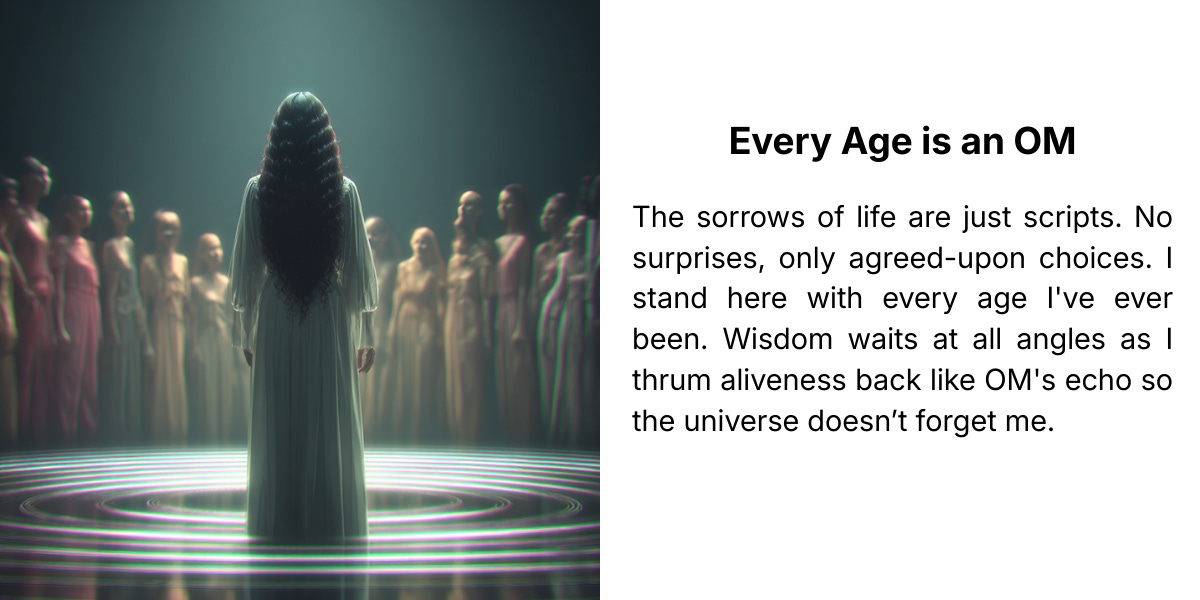
I’m running with my double—a twin who looks exactly like me but is happier and brighter. I challenge her to a race to the top of a mountain. As we run, I’m determined to win. I spot what looks like a tube slide and assume it’s a shortcut, so I take it.
But as I shimmy up the tube, my hips widen and I get stuck. “My birthing hips!” I yell. I realize I’m trapped in what feels like a birthing canal. My twin comes to the opening, but she doesn’t help me. Instead, she says, “Here, let this man who you love help you.”

Then he appears. A man I loved years ago, someone who abandoned me before ghosting was a thing. When I see his face and hear my twin say “this man who you love,” rage and fire light up inside me. When he reaches for me, I recoil in disgust.
I start waking myself up, and in the liminal state, I hear my angels saying, “You have to forgive, love.” I resist. “No,” I say. “I don’t have to forgive.”
I’m able to slip back into the dream. My twin stands there with her hands on her hips and says, “You would rather stay stuck in this tube than let this man who you once loved help you out.”
I say yes.

Taking shortcuts around your pain doesn’t get you ahead—it gets you stuck. My happier twin knew the only way forward was the long climb up the mountain, facing every step. I tried to bypass the journey and ended up trapped in my own birth canal, unable to be born into whatever comes next. The dream gave me a choice: accept help from the one who hurt me, or stay stuck. I chose stuck. Sometimes the pain you know feels better than the vulnerability you don’t.
But the dream didn’t just show me where I was—it showed me the cost of staying there. Weeks later, I reached out in real life. We had a conversation that was surprisingly easy and unexpectedly healing. I realized I’d been carrying a ghost story for so long. Neither of us were those people anymore. The dream didn’t force forgiveness—it planted the seed and let me find my own way out.
The Light He Couldn’t Steal
I’m about to do Reiki on someone—what my angels are calling “light touch.” I think it’s going to be my fifth-grade crush, and I’m genuinely excited. Fifth-grade Claudia would have been thrilled.
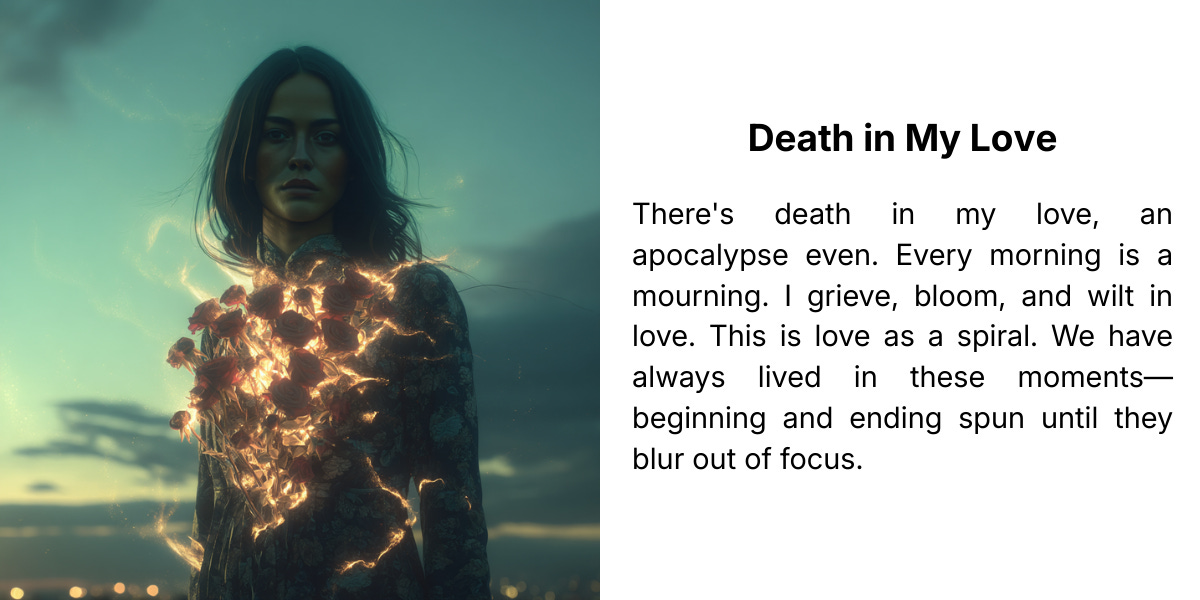
But at the last minute, they do a bait-and-switch. They tell me I’m actually going to do this work on my abuser—someone who hurt me when I was five years old. Fear and rage flood through me. I feel violated all over again. “How can you expect me to give my light to someone who tried to steal it?” I ask. I tell the angels this is a bad branch of the family tree that should just be cut off entirely. The message comes back clear: There’s magic and power in that branch, even though it was twisted into darkness. And there’s something very important about taking it back.
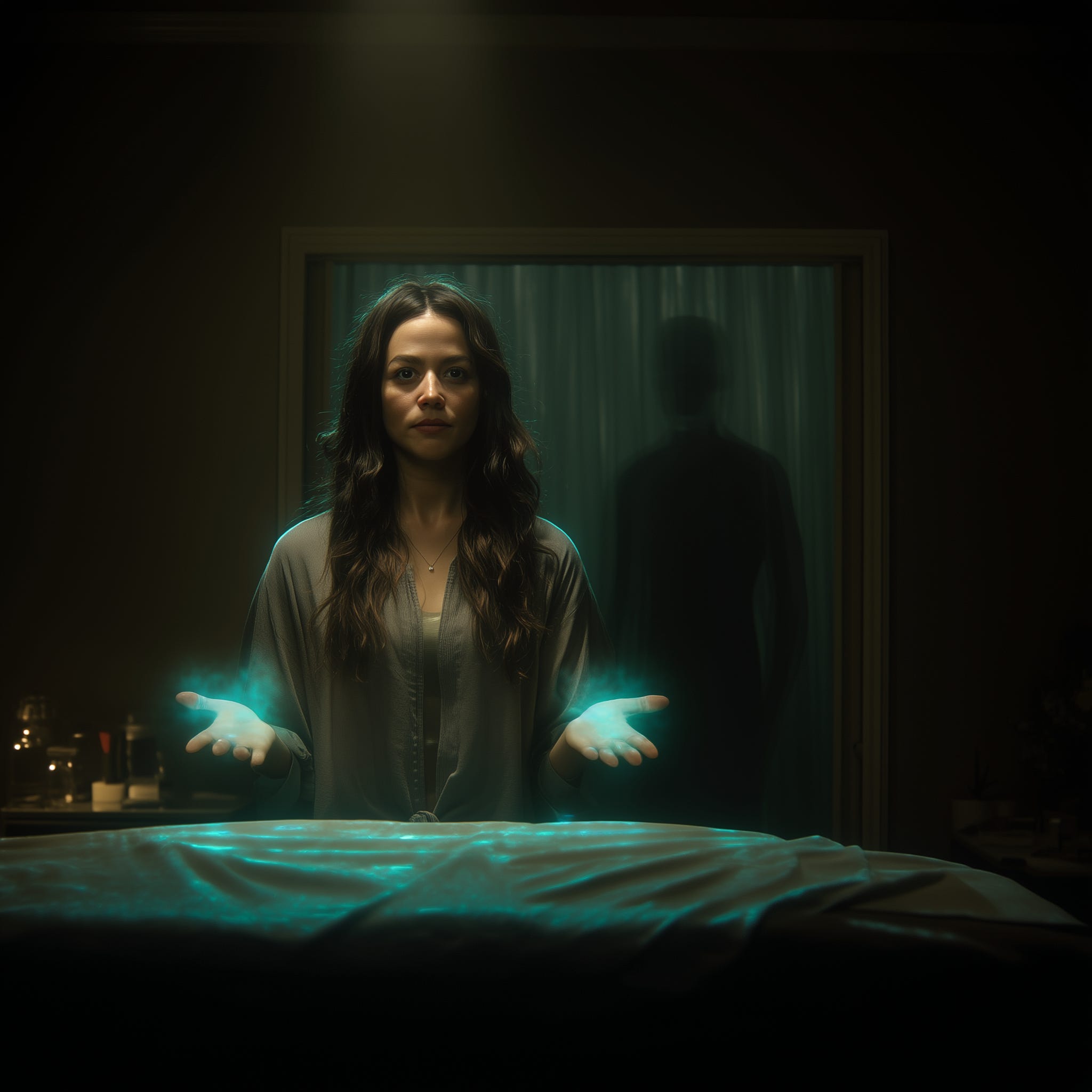
The dream isn’t asking me to forgive him or heal him. It’s asking me to take back what was always mine. The light he tried to steal was never his to take—it’s been lodged in that branch of the family tree, waiting. You’re not healing your abuser when you go back for it. You’re retrieving your own light. The power that runs through those branches, even the dark ones, belongs to you. Your light was never fully dimmed. It just needed you to remember where you left it.
The Spiral Branch
Someone I loved had died. I traveled down the road where his body was found. In that place was a white chalk outline of his body and the branch that had fallen from the tree to kill him. The branch was spiraling. I hooked it around my neck and carried it back with me. A symbol of love that never leaves, just weaves itself in and out of linear time like a strange attractor.
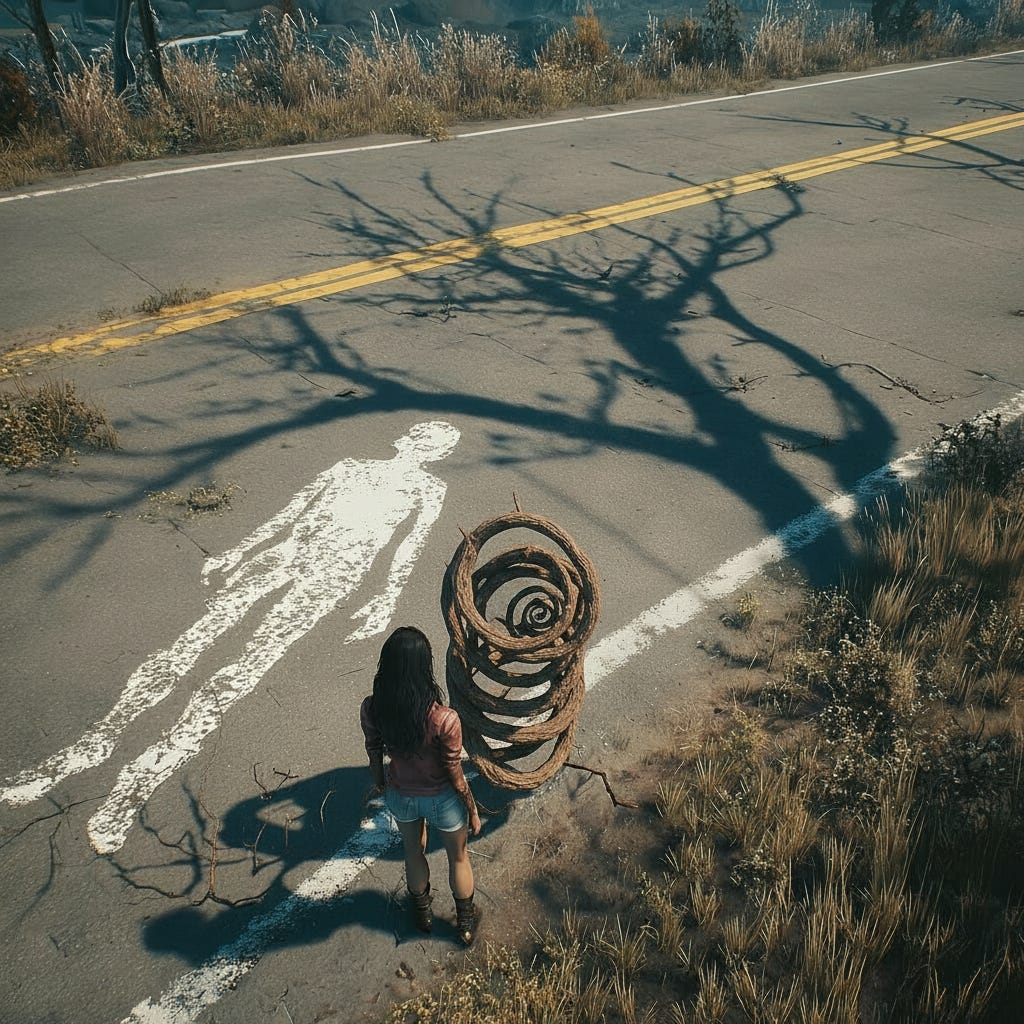
After you reclaim all your love from all these wounds across time, you realize love itself is non-linear. It doesn’t start when you meet someone and end when they leave. It spirals. It attracts. It weaves through time, persisting as a pattern, a frequency, or a pull you can’t escape. The person may be gone from this branch of reality, but the love remains—not as memory, but as an active force that keeps finding you in dreams. That’s what the spiral branch teaches: some connections don’t end. They just loop back around, showing up again and again, until you remember what they meant.
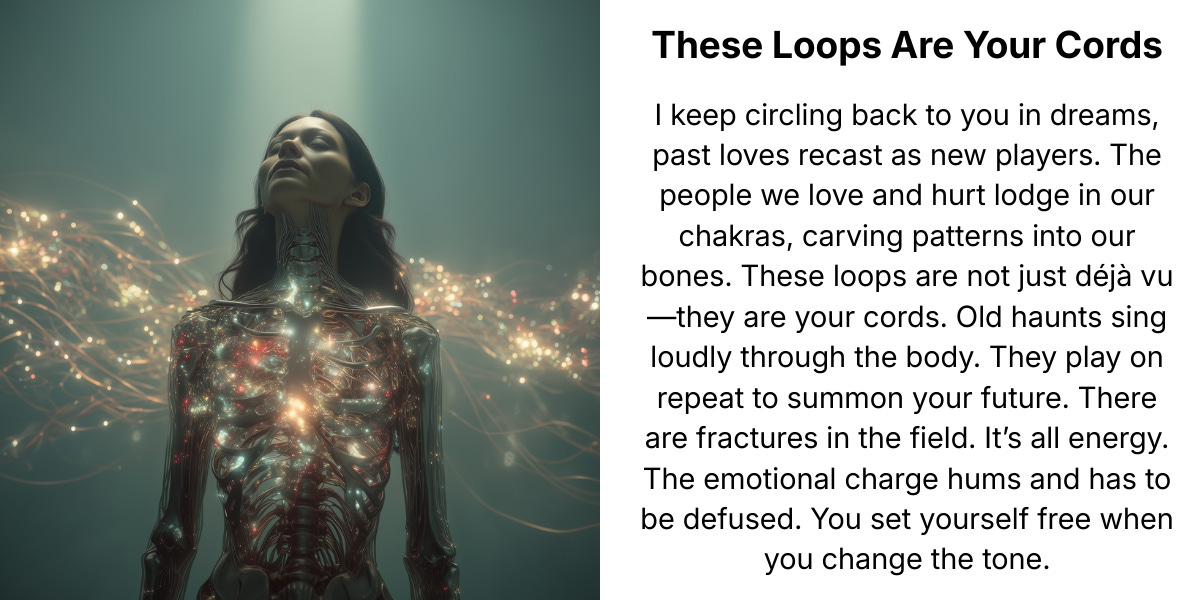
The work is simple, but not at all easy: follow the image, feel where it lands in your body, and ask, gently, “What love of mine is still here?” Let the dream show you the room, the age, the version of you who stayed behind, and meet yourself there without trying to fix or rush anything. In this cosmology, nothing is wasted—not the rage, not the grief, not the years you spent stuck in someone else’s story. Every loop is a cord you can take in your hands and slowly, patiently, pull back toward your own heart.

Claudia’s Many-Worlds Vision is a reader-supported publication. To support my work, consider upgrading to a paid subscriber. Subscribers who pay annually will also receive a complimentary hard copy of the Many-Worlds Vision book.